Working radically means returning to the core of work and creating value: for oneself, for the organization and for society. In this article, I outline the seven rules of radical working.
The term “radical” suffers from a harmful abbreviation. It is often equated with “proceeding or carried out with ruthlessness and harshness” or even with “representing an extreme political, ideological or ideological direction”. In fact, however, the Duden dictionary puts the interpretation“from the ground up, entirely; completely, thoroughly” in first place.
It’s not about revolution, but about a return to the essentials
Radikal Arbeiten takes up this latter meaning. It is not about tearing things down, about destruction and conflict, but on the contrary about returning to the essential, to the core of the work. This return should offer advantages for everyone involved: the working person, their environment (usually an organization and the family) and society.
But how does Radical Working work in practice? I have formulated seven simple rules for everyday work that can be used to implement radical working. However, the simple wording should not obscure the individual effort involved. Working radically requires creativity, self-honesty and stamina. But it can be practiced, even better in a group than alone.
Radical working generates benefits for all involved: the people working, the organization and society.
The seven rules of the game
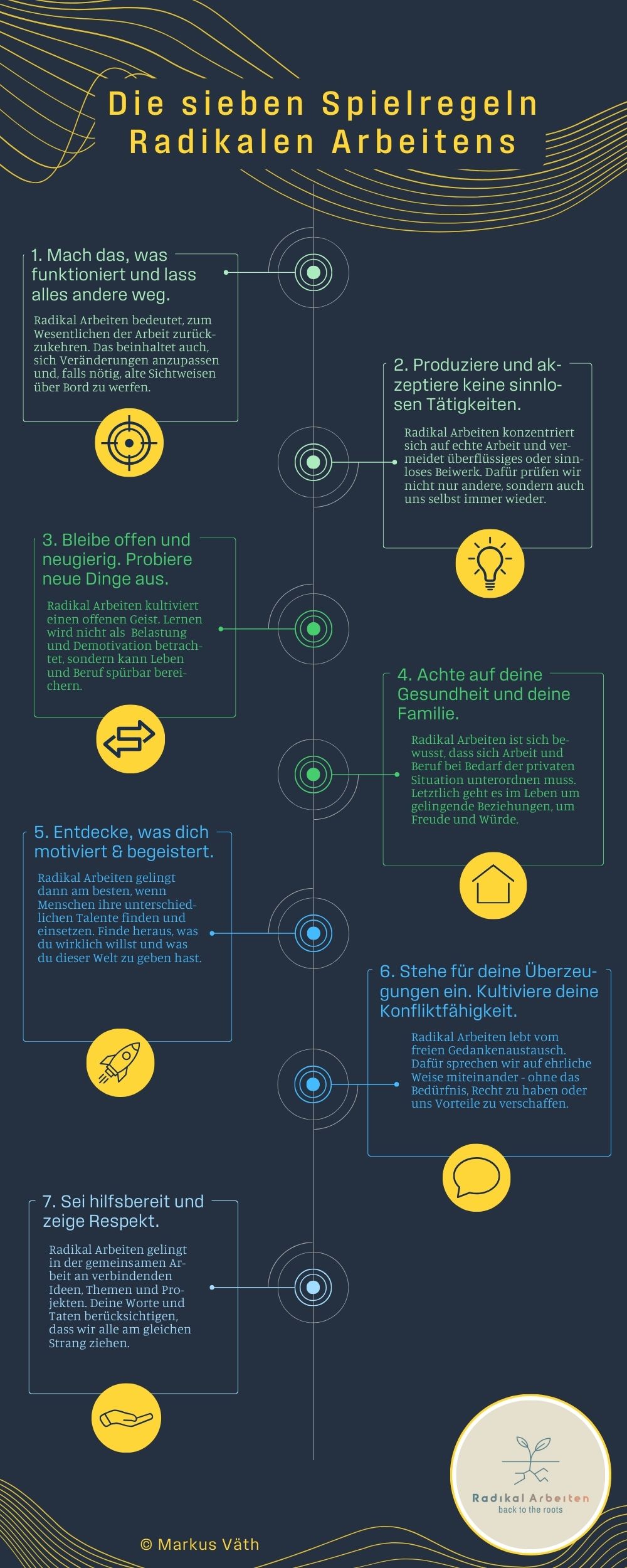
Do what works and leave out everything else. Working radically means returning to the essentials of work. This also means adapting to change and, if necessary, throwing old views overboard.
Do not produce or accept pointless activities. Radikal Arbeiten concentrates on real work and avoids superfluous or pointless accessories. To do this, we not only test others, but also ourselves again and again.
Stand up for your convictions and cultivate your ability to deal with conflict. Radikal Arbeiten thrives on the free exchange of ideas. In return, we talk to each other honestly – without the need to be right or to gain an advantage.
Discover what motivates and inspires you. Radical working works best when people find and use their different talents. Find out what you really want and what you have to give to this world.
Remain open and curious. Try out new things. Working radically cultivates an open mind. Learning is not seen as something stressful and demotivating, but can noticeably enrich life and work.
Be helpful and show respect. Radical work is successful when working together on unifying ideas, topics and projects. Your words and actions show that we are all pulling in the same direction.
Take care of your health and your family. Radikal Arbeiten is aware that work and career must be subordinated to the private situation if necessary. Ultimately, life is about successful relationships, joy and dignity.
It’s time we turned work on its head and stopped having superficial debates about working from home, four-day weeks or management fashions. It all starts with people. We have to take him seriously, we have to work with him. This is precisely where the working philosophy of radical working comes in.
P.S. The infographic below is part of a package that can be downloaded here (infographic in German and English, each as JPG and PDF).
Comments
About me
Markus Väth is an occupational psychologist and initiator of Radical Work. He is considered one of the leading minds for New Work and has been supporting organizations on leadership, culture and collaboration for over fifteen years. He is also a lecturer at the Nuremberg Institute of Technology.
He has documented his ideas and experiences in six books and 70+ articles and interviews, including for ARD and RTL. He is a columnist for CAPITAL and host of the podcast “Der Radikale Salon”.