Radical work brings work back to its roots: to real work without fake work and bureaucracy, to a working environment that is as free of fear as possible, to organizations that develop real dynamism and to activities that promote our individual strengths. Everyone benefits from this philosophy: people, organizations and ultimately society.
Mr. Väth, the term “Radical Work” sounds provocative at first. What is behind the concept?
First of all, I want to emphasize that Radical Work is not intended to be negative or destructive – on the contrary. Radical Work means getting back to the roots of work, to the “radix”: to real work without fake work and bureaucracy, to a working environment that is as free of fear as possible, to organizations that develop real dynamism and to activities that promote our individual strengths. All of this resonates strongly with human needs and brings us back to the essence of work.
You were active in the New Work environment for many years. Is Radical Work a new management fashion, a kind of “New Work 2.0”?
You might think so, but that’s not the case. In recent years, I have increasingly moved away from New Work for two reasons.
Firstly, New Work as a term has been completely emptied of meaning, with everything from coaches to AI software to furniture manufacturers. Some people who propagate New Work don’t even know that the concept was developed almost 50 years ago by Frithjof Bergmann, a social philosopher at the University of Michigan.
Secondly, New Work has become a soft ideology. Sure, freedom and personal responsibility are great. But what do people in organizations do if they don’t know what to do with it and just want to do their job? They start acting and swimming along somewhere. Lies and hypocrisy: the opposite of New Work.
That’s why I wanted to develop a concept with Radical Work that is simple, understandable and as flexible as possible. It doesn’t work as a management model either, because I deliberately didn’t develop a ready-made framework. At the core of Radical Work are just five simple principles of action that anyone can implement.
What are these principles?
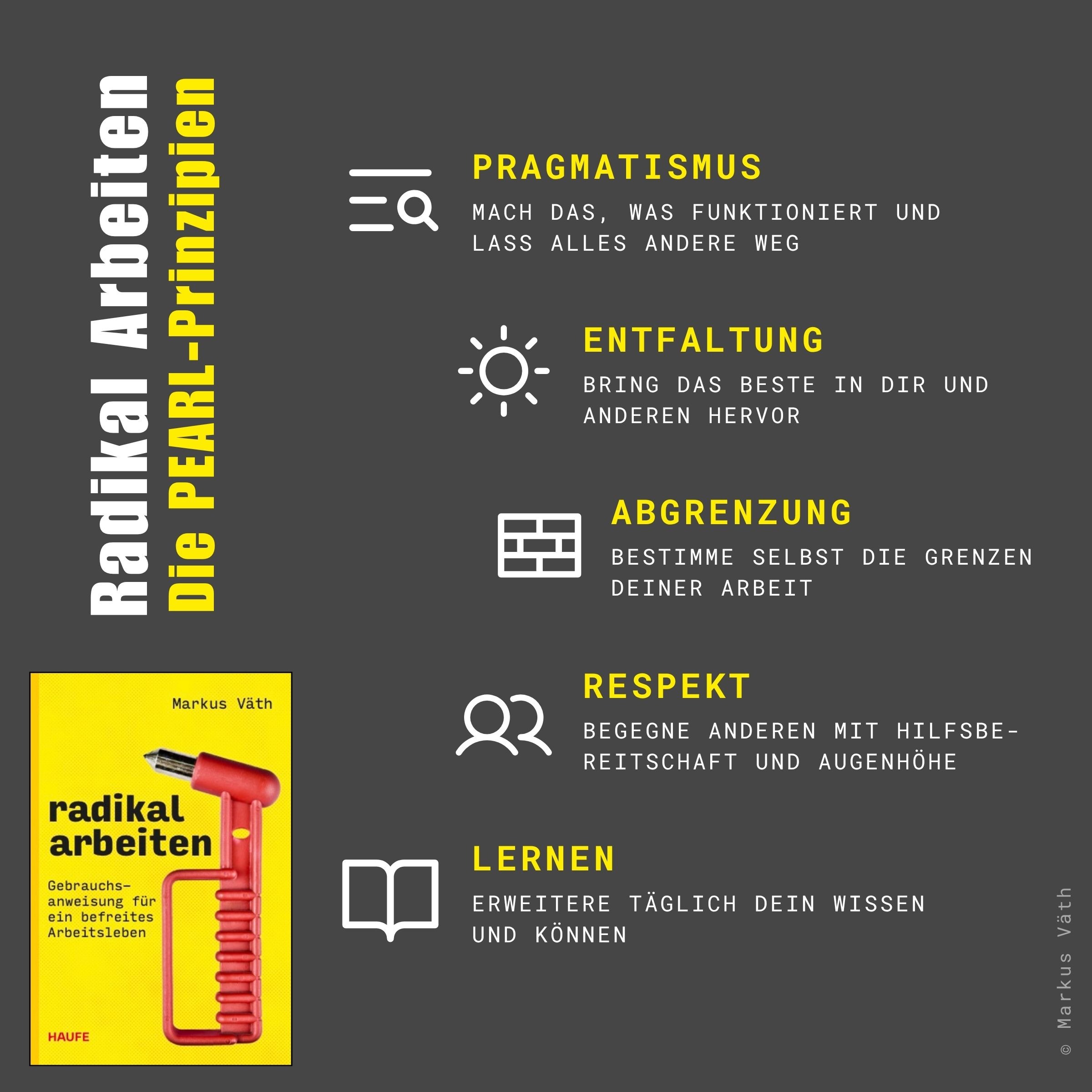
I call them PEARLs. There are five principles:
Pragmatism: Do what works and leave out everything else.
Evolvement: Bring out the best in yourself and others.
Boundary: Determine the boundaries of your work yourself.
Respect: Treat others with helpfulness and as equals.
Learning: Expand your knowledge and skills every day.
At first glance, these principles seem simple, almost banal. Their purpose is to inspire people, to make them want to work radically. Behind them are 30+ small and large tools for individuals, teams and entire organizations – all of which, by the way in my book in my book. And the best thing is that anyone who wants to work radically can and should add their own tools.
The HR department normally takes care of further training. They usually already have appropriate programs. How do you explain the added value of your idea to them?
I have been working with organizations for almost twenty years now. In practice, I encounter either large-scale change programs including project management, workshops and long durations. Or, on the other hand, you want to change people’s “mindset”, their values and attitudes. Even I, as a psychologist, find that intrusive.
With Radical Work, I place myself between organized change projects and mindset initiatives. Radical Work is an “action set” with concrete recommendations and skills. An instruction manual for a liberated working life, if you like.
One of my favorite sayings about Radical Work is: When many people do many small things in many places, they change the whole. Then even cumbersome change projects are superfluous.
Let's stay with the “many people”. What do you actually want to achieve with Radical Work as a whole? It's not supposed to be a management model.
I envision Radical Work as a movement. It would be great if every organization, from craft businesses and schools to SMEs, corporations and administration, worked according to the PEARL principles.
There should be meet-ups in small and large cities where people can share their experiences and ideas about Radical Work. An African proverb says: If you want to go fast, go alone. If you want to go far, go with others. And I want to go very far on the path of Radical Work – with as many others as possible.
I show how we can liberate our working lives and breathe a sigh of relief and make the case for work without bullshit, with clear principles and a desire for the future, so that we can focus on the essentials: Making work better for all of us.