
Back to real work
Radical Work brings work back to its roots: to real work free of “fake work” and bureaucracy, to a fear-free work environment, and to genuine dynamism within organizations. Everyone benefits from this philosophy: people, organizations, and ultimately, society as a whole.
“The central capitalist promise of ‘performance in exchange for security’ no longer holds. Radical work is the only meaningful response to this.”
Markus Väth
Radical Work is a practical, psychologically grounded philosophy for individuals and organizations. It lays the foundation for a new relationship between people and organizations and a new vision of the world of work.
In today’s so-called “flexible capitalism,” organizations—inevitably—pass on the uncertainties from their environment (in the form of unpredictable political conditions, high energy prices, uncertain business models, etc.) onto their employees (in the form of fixed-term contracts, increased layoffs, rapidly changing job requirements, the “threat” to employment posed by artificial intelligence, etc.).
This spillover of economic uncertainty is radical in that it makes the long-term life planning that was once common impossible. The “psychological employment contract” that used to apply has been severely shaken. People in the workforce must therefore also “radicalize” themselves (in a constructive sense):
Going beyond an analysis of the world of work, “Radical Work” offers a four-part vision:
This vision is rooted in the philosophical assumption that work is not something to be endured, but rather something that can be shaped in a positive way. Work is not a fate, but a (certainly demanding) opportunity for self-realization.
If we follow philosophers such as William James and Henri Bergson, the ultimate purpose of human work—of all work—is to be “useful.” Usefulness takes on quite different forms here—for example, as a source of personal meaning or as a contribution to the organization’s purpose. Usefulness, as understood in Radical Work, is thus rationally grounded and normatively justified.
To avoid losing touch with reality and getting lost in the “icy deserts of abstraction,” Radical Working proposes practical principles for action.
These five PEARL principles serve as guidelines for day-to-day practical work and the decisions made in that context. People who act in accordance with these PEARL principles increase the value of their personal work and the value created by their organization.
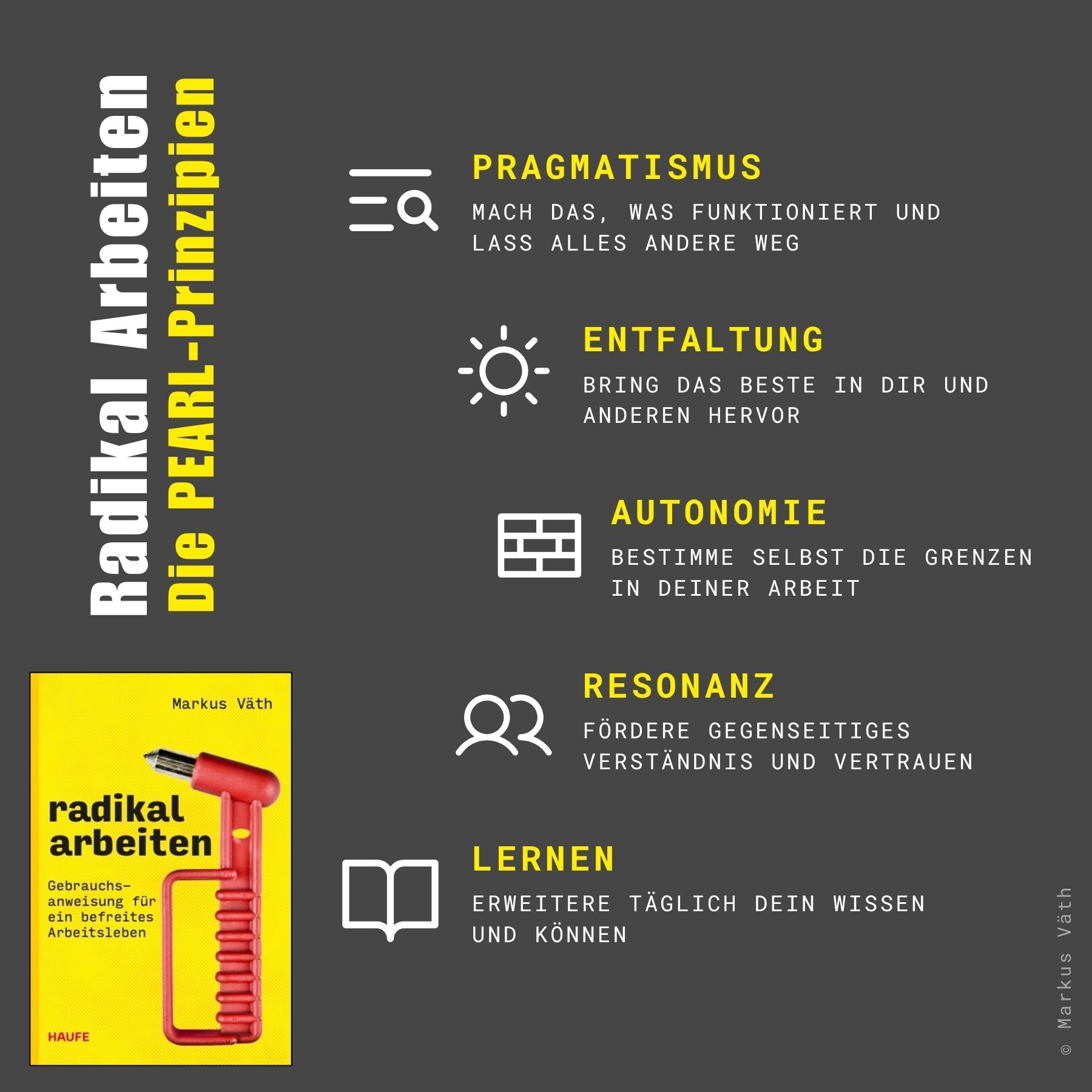
First of all, I want to emphasize that Radical Work is not intended to be negative or destructive – on the contrary. Radical Work means getting back to the roots of work, to the “radix”: to real work without fake work and bureaucracy, to a working environment that is as free of fear as possible, to organizations that develop real dynamism and to activities that promote our individual strengths. All of this resonates strongly with human needs and brings us back to the essence of work.
You might think so, but that’s not the case. In recent years, I have increasingly moved away from New Work for two reasons.
Firstly, New Work as a term has been completely emptied of meaning, with everything from coaches to AI software to furniture manufacturers. Some people who propagate New Work don’t even know that the concept was developed almost 50 years ago by Frithjof Bergmann, a social philosopher at the University of Michigan.
Secondly, New Work has become a soft ideology. Sure, freedom and personal responsibility are great. But what do people in organizations do if they don’t know what to do with it and just want to do their job? They start acting and swimming along somewhere. Lies and hypocrisy: the opposite of New Work.
That’s why I wanted to develop a concept with Radical Work that is simple, understandable and as flexible as possible. It doesn’t work as a management model either, because I deliberately didn’t develop a ready-made framework. At the core of Radical Work are just five simple principles of action that anyone can implement.
I have been working with organizations for almost twenty years now. In practice, I encounter either large-scale change programs including project management, workshops and long durations. Or, on the other hand, you want to change people’s “mindset”, their values and attitudes. Even I, as a psychologist, find that intrusive.
With Radical Work, I place myself between organized change projects and mindset initiatives. Radical Work is an “action set” with concrete recommendations and skills. An instruction manual for a liberated working life, if you like.
One of my favorite sayings about Radical Work is: When many people do many small things in many places, they change the whole. Then even cumbersome change projects are superfluous.
I envision Radical Work as a movement. It would be great if every organization, from craft businesses and schools to SMEs, corporations and administration, worked according to the PEARL principles.
There should be meet-ups in small and large cities where people can share their experiences and ideas about Radical Work. An African proverb says: If you want to go fast, go alone. If you want to go far, go with others. And I want to go very far on the path of Radical Work – with as many others as possible.

I’ll show how we can free ourselves from the constraints of our work lives and breathe a sigh of relief, and I’ll make a case for work free of “fake work”—work based on clear principles and a passion for the future—so we can focus on what really matters: making work better for all of us.


